

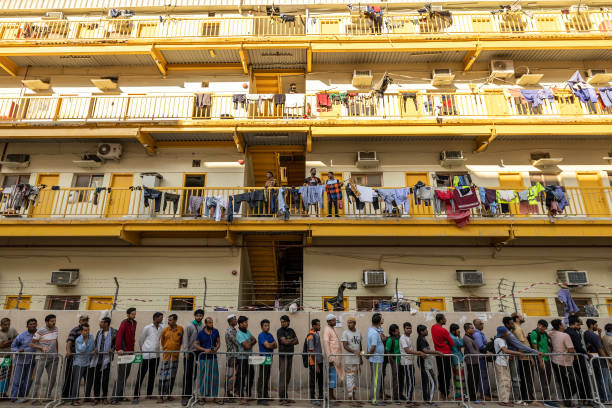
The crystal waters of the Persian Gulf wind between towering skyscrapers of futuristic design. The wealthy reside in mansions and penthouses along the coastline as tourists gawk at the opulent “City of Gold.” Yet at the same time, on the outskirts of the city live impoverished laborers, concealed so as not to disturb the affluence they surround. Dubai, the jewel of the United Arab Emirates (UAE), pushes away the reason for its success: foreign labor.
As stated by Walking Free, an international human rights organization, the UAE has an estimated “132,000” people working in modern slavery conditions. What’s more, according to the Migration Policy Institute “as of 2019, immigrants make up about 87.9% of the total population” largely coming from South Asia. These individuals are behind UAE’s rise, the hidden infrastructure powering it, traveling to the Middle East for employment in labor-heavy jobs. After arriving in locations like Dubai, migrants face demanding work, unsuitable living conditions, and limited protection. Possessing limited legal rights, employees receive little pay and many are in debt. Average summer temperatures in the UAE can exceed 100 degrees, and workers are expected to labor long hours outside. They return to sleep in bunk beds or on the floors of cramped, single-room standardized apartments they share with countless others. The conditions the migrants face isn’t new; rather, it has only progressed from a system the country was established upon.
Historically, migrants have toiled under an oppressive regime called the kafala (sponsorship) system that ties workers to their sponsors. In exchange for travel and housing, the kafeel (sponsor) gains full authority over their workers’ employment and immigration status. This level of control creates a severe power imbalance where the kafeels are able to effectively take over the lives of the foreigners. Females are especially vulnerable, facing physical and sexual abuse from employers in addition to experiencing discrimination from the male-centric goverment. Although this practice is illegal under Emirati law, the reality is that the kafala system is still relied upon by employers.
“I think that the UAE trying to get rid of the system in place will always be ineffective,” commented freshman Ava Hall. “They built the country by taking advantage of migrants and won’t know another way to function.”
This is where the problem lies. How can a country whose foundation has been built upon the backs of migrants turn away from its source of success? Protesting, news exposure, and unrest will not be enough. To make real change, the United Arab Emirates requires significant societal reform. But until their economy is impacted by the practice, they have no reason to eliminate their way of life.
With the luxury brands, contemporary architecture and famous tourist locations, the UAE continues, and will continue, to draw tourists, business and power. So if visiting Dubai means supporting their migrant exploitation, it poses the question as to whether the visit is really worth it.