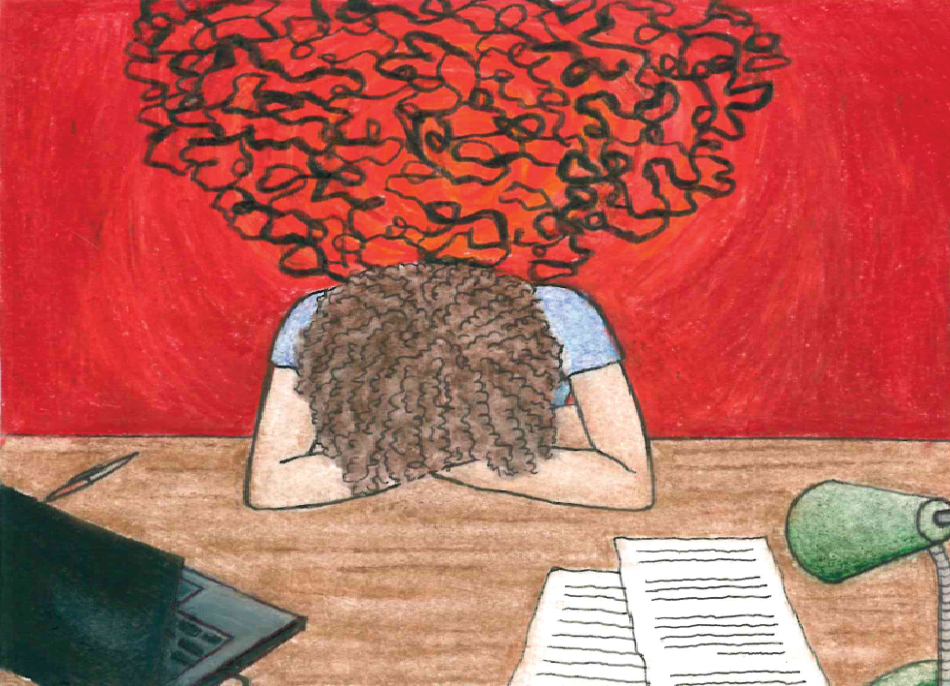


The majority of teens use social media and spend hours scrolling online to cure boredom, fill time, or just give their brains a rest. Although temporarily fulfilling, the mindless consumption of digital media can have serious negative effects on your brain function and mental health.
“I never get things done, and then I forget everything after I scroll,” said freshman Isabella Tan. “Every scroll I’m searching for happiness, but I never find it.”
Social media platforms like Instagram, YouTube, and Facebook allow users to easily watch short videos and posts personalized to their interests. A reason that it might be so hard to stop scrolling is that every video is like a hit of dopamine–for every post a user sees, they get a laugh, entertainment, or a new fact. While scrolling, the brain adapts to getting quick rewards; in turn, attention spans decrease. When the brain becomes used to getting quick gratification with little effort, it becomes harder to complete longer tasks such as homework and chores.
The quick reward system of scrolling on social media can be very addictive, requiring minimal effort, and thus can take from time spent with friends, doing schoolwork, or pursuing a hobby.
“We’re too distracted by the phone because it’s so appealing,” Health teacher Emily Dolim said. “[It leads to] diminishment of meaningful real life experiences because we’re investing more time in our phones alone than in connection with other people.”
The allure of social media platforms comes from the way they are designed. The platforms track the posts users engage with and run that data through algorithms. Algorithms are coded to analyze the tracked information to deliver recommendations that match users’ interests. The resulting personalized recommendations on their feed are more likely to be found entertaining, keeping them scrolling for longer.
Consuming social media can also disrupt sleeping habits, with users staying up late scrolling and being exposed to blue light before sleep. Getting good sleep is important for health and body function. It allows you to regain energy, which is necessary to have to be able to perform well academically. Exposure to blue light before sleep suppresses melatonin, a hormone that regulates and induces sleep. It leads to lower quality of sleep, and in turn, poorer performance in school.
Another risk of constantly taking in content on social media without a chance to properly understand and absorb the information is that critical thinking skills diminish. The sheer amount of information consumed in just one sitting of scrolling is overwhelming. A 2025 survey conducted on adults in the U.S. by Statista found that about 46% of respondents see false or misleading information online daily. Another Statista survey concluded that only 19% of respondents, U.S. adults, were very confident in their ability to differentiate true from false news. Because it is hard to make this differentiation, it’s important to mull over any news seen online, particularly on social media. It’s much easier to accept that what we see online is true, especially when the information is delivered by an influencer or if it agrees with our ideology, even though a large portion of news is false.
Social media platforms can be great ways to connect with friends and keep up with trends, but when scrolling starts to become an addiction, it poses significant problems. However, there are many ways to combat addiction to scrolling. One of the best ways to stop using your phone is to replace that time with another activity. Oftentimes, people use scrolling as a way to occupy themselves during free time, but there are many other things they can focus on. One alternative is taking up a new hobby or returning to an old one, such as art or a sport.
“I play tennis, so I go out and play tennis or some other sport,” freshman Olivia Rogers said. “I also do piano, so I do any hobbies that I have…instead of [scrolling].”
Participating in artistic pastimes can keep you off the screen while boosting morale and creativity. If you’re interested in engaging in artistic hobbies, there are many to choose from. Drawing, painting, creative writing, and playing instruments are all ways to stop scrolling and improve your mental health. Monte Vista offers numerous outlets for creativity. It has artistic classes including ceramics, art, theater, band, choir, photography, and more.
Another thing that can replace scrolling is participating in sports or any physical activity. Not only does it keep you off the phone, it is also crucial to maintaining your physical and mental health. Monte Vista’s sports teams and clubs are good ways to get involved in more physical activity both in and out of school.
Most devices and social media platforms also have features that allow you to set limits for yourself. These can be really helpful to regulate the time users spend on their phones. They send notifications to pull you out of the scrolling cycle or block you from using the app completely.
“If someone were to have time limits on their phone they’re forced to go to sleep or do another activity… I think that can really help in the long run,” said freshman Nyomi Francis.
Overall, scrolling poses many negative effects on both physical and mental health, but it isn’t necessary to stop completely. Using social media isn’t harmful when used from time to time, though it’s better to replace it with a pastime off the screen. The main thing to remember is using social media in moderation and not letting it affect more important aspects of your life like health, school, and social life.