
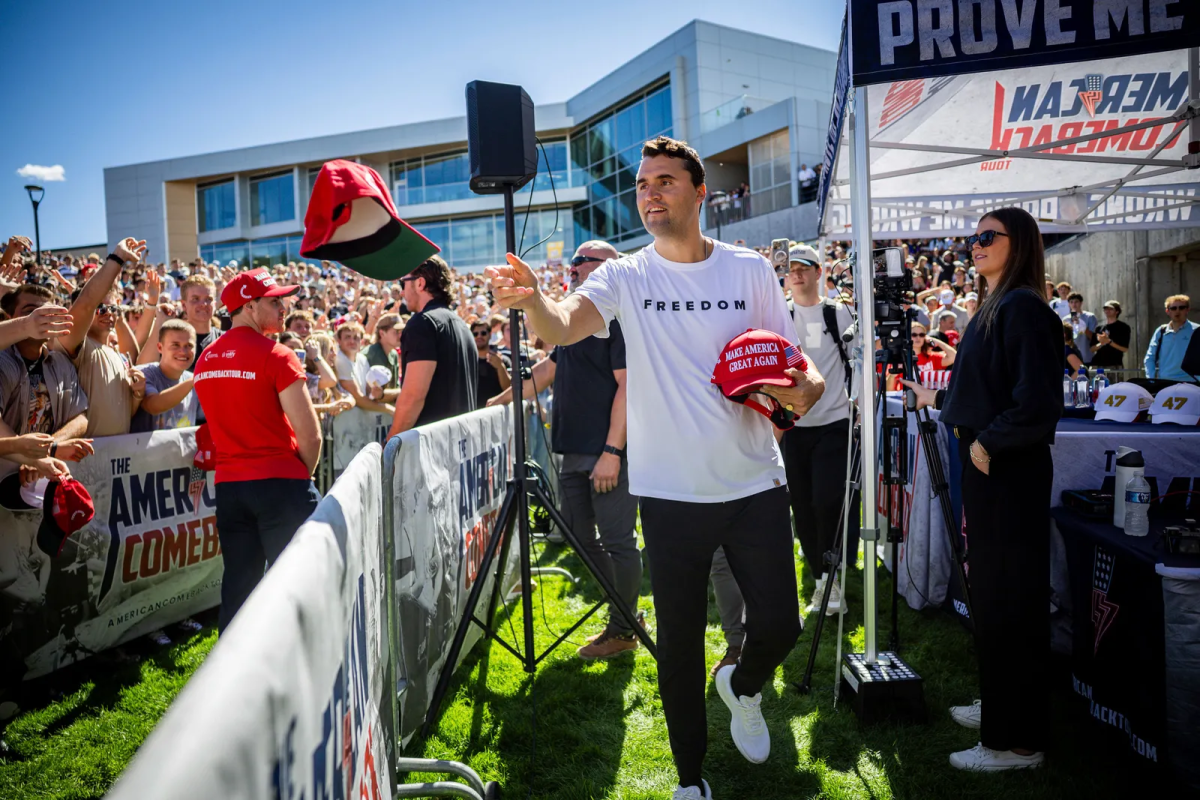
On September 10th, right-wing influencer Charlie Kirk was fatally shot in the neck at a conference in Utah. The perpetrator has been identified as Tyler Robinson. Following the mass media coverage and White House statements, suspicion has risen regarding the background of the shooter, his intentions, and potential red herrings in the aftermath.
Utah prosecutors publicized a series of texts between Robinson and his roommate, which consisted of a full confession, intermittent Gen-Z slang, and the phrase “my love” more than once. Steve Bannon, former adviser to President Trump, has called the string of messages “too stilted, too much like a script” (Al Jazeera). Additionally, Robinson’s background is in electrical engineering; he received a scholarship to Utah State for his acumen in high school. He has never served in the military, and his family states he didn’t hunt or frequent shooting ranges.
Minutes after the news of Kirk’s death, Israeli Prime Minister Benjamin Netanyahu was among the first to mourn the loss. His post came even before President Trump shared any words. His statements included proclaiming Kirk as a “lion for Israel, ” (CNN) and for being a staunch American supporter of a foreign government. Yahoo! News posthumously examined Kirk’s attitude towards the Netanyahu government, tracing statements of open criticism regarding their activities in Gaza, political coups, and more. Netanyahu, amid a barrage of accusations, had to speak out multiple times and deny Israel’s involvement in the assassination. Long-time friends of Kirk’s, such as Tucker Carlson, have described Netanyahu’s response as “a proxy war of his (Kirk’s) memory.” Carlson said Netanyahu attempted to paint Kirk as a martyr for Israel, claiming this was a deliberate “attack on a Christian nation”.
Mere seconds after the shot was heard, a 71-year-old George Zinn was heard confessing to the crime, and to “let the suspect run free,” (BBC). Based on the aforementioned messages, Utah prosecutors claim the senior man had no connection to Robinson. Inevitably, Zinn provided a distraction allowing Robinson to evade the police for multiple hours. Soon afterwards, Zinn was taken out of custody and left free of charge, without further investigation. “I think he was definitely trying to draw attention to himself away from the killer,” Sophomore Nancy Sun states.
Uniformly, amongst the left and right, Kirk’s death has been classified as a political assassination. Prominent voices from both factions, like Tucker Carlson, Candace Owens, Mehdi Hassan, and more, have expressed their vehement anger towards this method of “silencing” (Candace). Cenk Uyghur, a leftist political commentator, was featured on Tucker Carlson’s show in vested conversation and agreement with Carlson. Both expressed their deeper fears for the implications Kirk’s death has. The polarization of this issue has dissipated, with unanimous concerns on all sides.
Since the exact motives of the killer are unconfirmed, with messages stating,
“I had enough of his hatred. Some hate can’t be negotiated out.” It is unclear how veritable surrounding matter and reports are. Authorities have not confirmed what “hatred” Robinson refers to specifically. A bigger question remains: Is this subversion of the American people? Independent journalists and political commentators have expressed fear for their safety, and the perceived dangers of free speech. “He expressed his opinions through the first amendment…his assasination was a violation of his…rights.” Sophomore Sakina Ahmad says.
Recently, Owens shared a series of private messages from a group chat. Kirk: “…I cannot and will not be bullied like this. Leaving me no choice but to leave the pro Israel cause” Owens, corroborated by TPUSA spokesperson Andrew Kolvet, enumerated that Kirk knew political assasination would be his end. Other commentators fear Kirk may be the first of many to be silenced, especially given his shift of perspective on highly contentious views, like his most recent tapering support of foreign nations.
With over 20 million people streaming his memorial and 100,000 live in the stadium, standing in vigil, Charlie Kirk’s death has garnered international concern. Political assassinations often resonate generationally, magnifying the actions of opposition and potential corruption. “It globally affects [us]… resulting in our constant fear and terror that we will be persecuted for our…opinions.” Ahmad adds. Amid recent attacks on journalists and students, now buttressed by Kirk’s death, the question begs: Does our government protect our political opinions?