

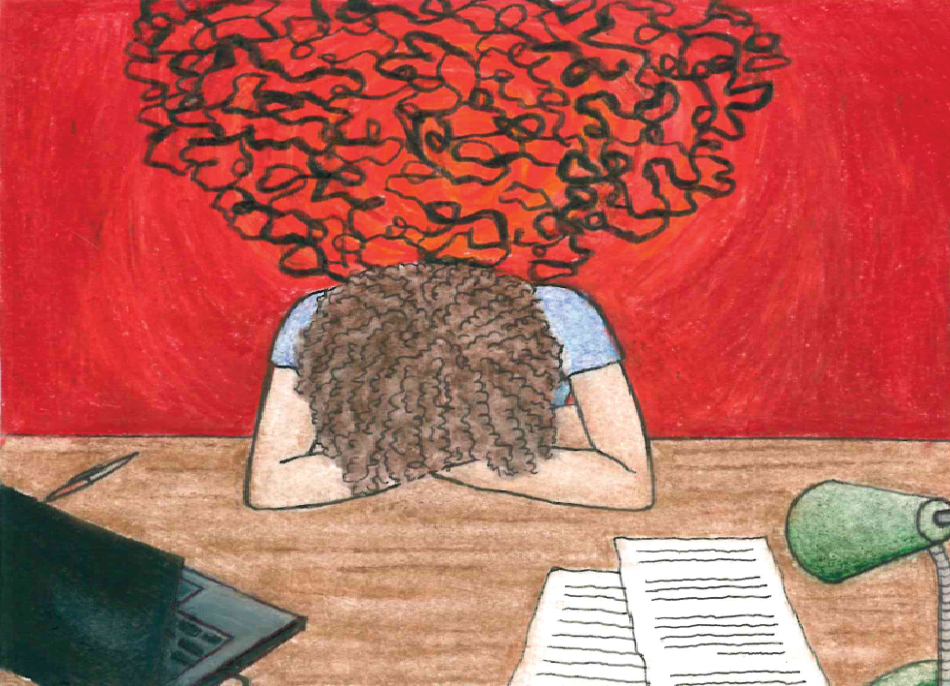
Four or more AP classes, extracurricular activities, volunteer work, math competitions–unfortunately, this is a story many students in the Bay Area are familiar with. While it’s true that some students who follow this model are successful, many overload themselves and burn out. And it’s not because some people were born academic weapons, while others crumble under the pressure. People’s personal lives are so critical to their assessment of any obstacle and their ability to mitigate numerous stresses. The current state of the world isn’t too fancy either. Pervasive conflict, corruption, genocide; the works. Our world is becoming an increasingly unstable place, and the rat race that is college admissions doesn’t help. Local schools have responded by limiting the number of AP classes students can take, reopening the public forum on academic pressure. The question remains, will these measures help, and how will students receive them?
“There have been two student deaths at Emerald…I don’t know for sure the cause of death…but I think these measures were taken to help improve student mental health.” Safiya El-Rahman, Freshman at Emerald High in Dublin, is good friends with the sister of one such said student. As of January 13, 2026, The Dublin Unified School District unanimously limited each student to no more than four AP or Honors classes per year, with no more than 11 before graduation (Pleasanton Weekly). “..I am planning on taking two AP classes next year…I don’t want to overwork myself just to meet an unachievable standard that [costs] me my own sanity.’ El-Rahman adds. Students could theoretically only take an exorbitant amount of AP classes if they are involved in multiple subject areas, including advanced math, English, science, and more. Colleges in England, like Oxford and Cambridge, immensely prefer students to demonstrate preparedness and precedence for their major, rather than the entire course catalog. Several difficulties also arise when students are unable to balance coursework for variegated subjects with little to no similarity in practice or material. “…on the outside, most students look fine and look like they are flourishing but [inside] they are not. They push and they push until they finally break.” El-Rahman adds.
The same holds true for private schools as well. Surayah Jalal, Freshman at Carondelet states,
“I really love the fact that we have an AP limit because it makes me feel less stressed about the future…by limiting the number of APs, schools are caring more about the student as a person rather than just an academic weapon.” Carondelet has an AP limit of two for sophomores, and a different curriculum structure. Rather than the typical Biology, Chemistry, Physics route, these students take science classes backwards, expanding concepts outward–quite literally from the smallest building block of the universe to the wider biosphere. Their clothes aren’t the only thing in uniform; since all students have the same constraints, Carondelet informs universities of their policies to level the playing field. This, culminated with more free time, allows students to engage in extracurricular activities and sports, buttressing their resume and appearance as a real human being, rather than another number. With all items considered, who is more college-elligible? An overworked MV student taking 5 weighted classes, or any other student taking 2 APs, with plenty of time for family, volunteerism, hobbies, and life?
AP classes are fixed, people’s personalities and life trajectory are not. While perseverance is a personal battle, peer pressure and social expectations may pose a collective threat to students. Hence, does the problem lie within innate academic culture, or the toxicity created by colleges, pitting students against one another for a spot to work and serve some big guy in charge anyways?