
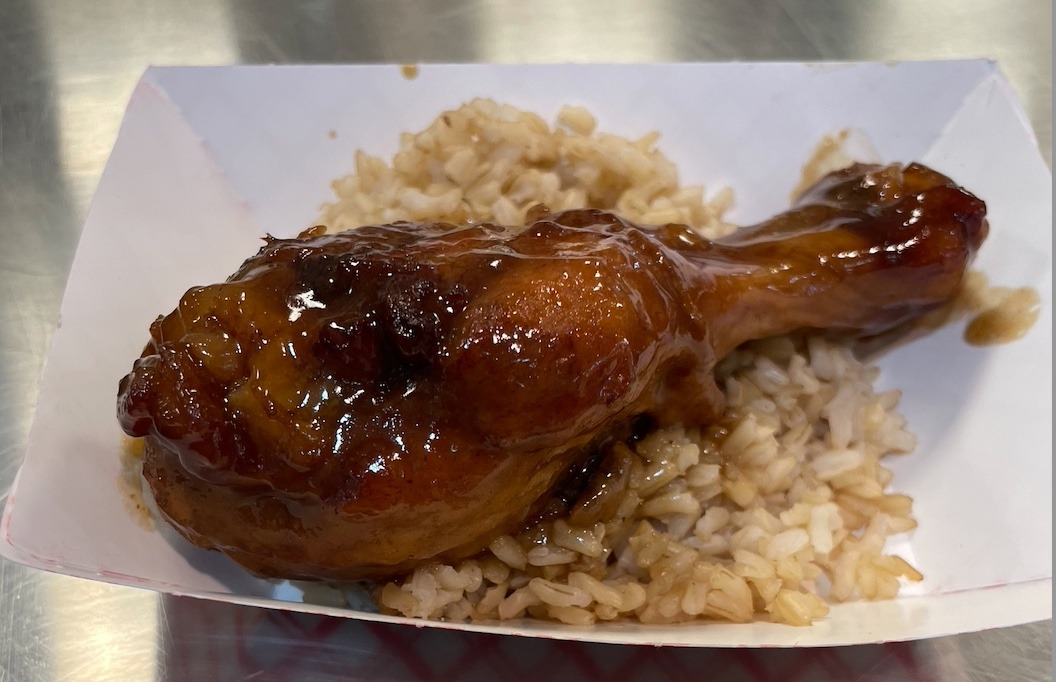
For years, the food provided at Monte Vista, as well as other schools in the San Ramon Unified School District (SRVUSD), has lacked certain menu options for those who choose a halal diet for religious, health, or ethical reasons. However, along with their persistent effort to improve choices on the lunch menu, the SRVUSD updated the high school lunch menu at the beginning of the 2025-2026 school year in August, to include Halal alternatives.
Halal food options, such as chicken and beef, are now featured on the lunch menu, consisting of a freshly prepared Halal-certified beef hamburger and roasted chicken thighs.
“We wanted to make sure that when we added it, that it would be a very high quality protein,” said Zetta Reicker, Director of Child Nutrition & Warehouse for the SRVUSD. “It actually is an item that is brought in raw and we do cook it from scratch, which is a pretty big achievement for the cafeteria staff.”
The lack of access to Halal food options on school lunch menus has been a major problem for Muslim students, who make up a significant portion of students across the country and at Monte Vista. In fact, the Pew Research Center estimates that by 2040, the Muslim population in the United States will be the nation’s second-largest religious group.
“The addition of halal food to the school menu has made me feel appreciated as an individual at Monte Vista,” said Junior Sabrina Tariq. “I enjoy having more options to choose from rather than just grabbing the thing that had no meat in it. Before, I would meticulously check each food packaging to see if there was any meat hiding around in the item. My options were very limited and I would often just skip lunch due to the lack of variability.”
Junior and student kitchen worker Vanessa Wu who works in the cafeteria during lunch period comments on the significance of these changes that she has seen firsthand.
“Before we had halal food, there would be students asking if the meat was halal,” said Wu. “But now that we have halal food, they just take it because it says halal.”
Halal food plays a major part in the Muslim community, and is often confused with other diets such as vegetarian food. While most vegetarian food is halal, this is not always the case. A halal diet consists of food that is allowed under Islamic law, as described in the Quran, while vegetarian food merely excludes meat. Halal is an Arabic word meaning “lawful or permitted”, contrasting with the word haram. This word extends to Islamic dietary practices with food and drinks, as well as other products. These laws are extensive and emphasize cleanliness, purity, and the ethical treatment of animals. In fact, the practice towards meat products is meant to minimize suffering, being performed in a quick and efficient manner. The rules surrounding meat consumption provide that animals must be slaughtered in a particular way. Meat that has not been slaughtered with these techniques are considered haram.
Overall, the school lunch menu at MV is always changing and improving, in order to cater to the current needs of our students. When asked about one thing that she would like other people to understand about food provided by the school, Reicker leaves her final recommendation.
“Give it a try and see that it’s delicious and that it is nutritious, and that the food, the sourcing, [and] the source of the food is very high quality,” said Reicker. “Now I will say we still have things like Boscos…so we do try to balance it…I would just say, give it a try and see what you think.”