

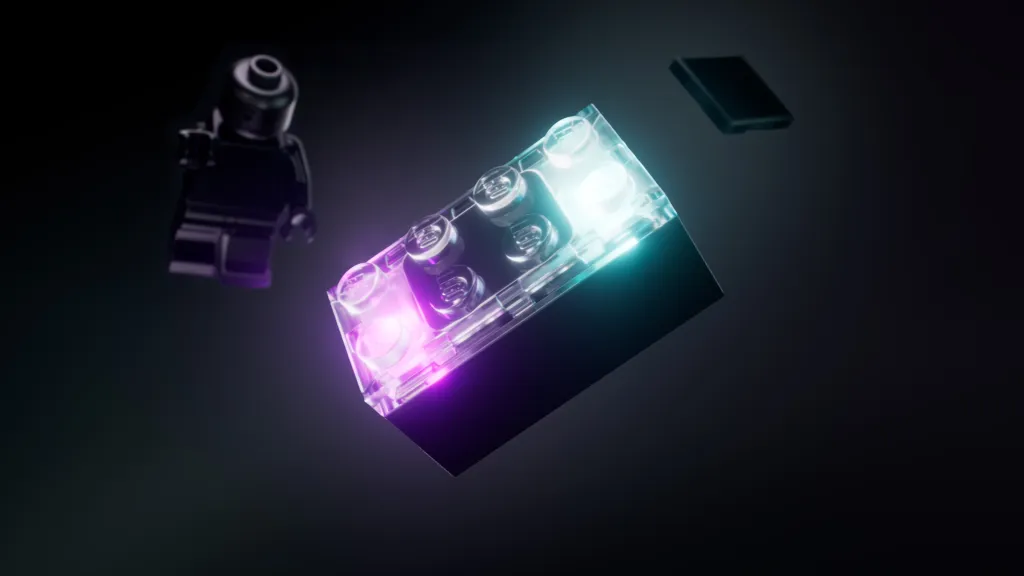
First announced at a tech show in Las Vegas, Smart Bricks have caught the attention of Lego fans all over the world.
According to the Lego Group, at least 400 million people have picked up a Lego set at least once in their lives, whether it be constructing a Lego X-wing or building a Lego duck from a handful of bricks. Now with Smart Bricks, Lego sets will react to interaction with an array of sounds depending on how the Lego is being used. Imagine that bright yellow Lego duck quacking as it slides across the floor, or the X-wing zooming through the air as Luke Skywalker fights a platoon of imaginary enemies.
All this and more is coming with the arrival of Smart Play, Lego’s new digital system, releasing on March 1st, 2026. The Smart Play system is composed of three essential pieces: The Smart Brick, Smart Tag, and Smart Minifigure. Each component plays an essential role in the Smart Play experience.
The Smart Brick is the beating heart of the system. It makes the sounds, flashes the lights, and decides what noises to play depending on the position of the Lego. To achieve this, one Smart Brick is packed full of motion sensors, responsive lights, sound synthesizers, accelerometers, and color recognition scanners, all of which are charged wirelessly by a special port. Because of this technology, Legos will respond to play with sounds and lights that will change depending on how you play. In the upcoming X-wing set, one of the first to feature the Smart Play system, the brick can sense when a Lego hammer or fuel nozzle is attached to it and then make the appropriate sounds.
If Smart Bricks were workers, then Smart Tags would be their boss. Thanks to the sound synthesizer in the Smart Brick, it can make any noise imaginable, but the Smart Tag tells it exactly what to be and what sounds to make for specific play scenarios. Each Smart Tag corresponds to a different creation. There’s a smart tag for a duck, a smart tag for a boat, a smart tag for a car, and so on.
In addition to Smart Bricks, the Smart Play system includes Smart Minifigures. The minifigure acts in a similar fashion to the Smart Tag, more like a key for the Smart Brick to imitate that character. Additionally, each minifigure has different personalities, which can be discovered by playing with the minifigure. For example, if the user is flying an airplane upside down, the minifigure might scream in fear. However, a different minifigure might whoop with joy, depending on its personality.
“[SmartBricks] would get me to play with [Legos], instead of just keeping them on display,” said Richard Henríquez, a Spanish teacher and Lego enthusiast.
However, by adding colorful additions like lights and sounds to Legos, many adults and teenagers alike are concerned that the age of intricate, delicate, and statuesque sets that has become a staple of Lego products is coming to a close.
“They’re good for kids, but it’s not going to affect me or anyone my age,” said Zayan Bokhar, a freshman Lego enthusiast.
Bokhar isn’t the only one. Ten students interviewed on this same topic all gave similarly negative opinions on this latest edition to Lego. If the Lego company doesn’t act soon, they could lose their large base of young adult fans.
One of the more interesting aspects of the Smartplay system is how all three components communicate to provide the ultimate experience. But who says that’s all the Smart Play system can do? Of course, the moment Lego introduced wireless into the system, they opened up the question of privacy. There have been cases in the past where information collected by digital toys have been grossly misused. The Lego company maintains that privacy was their first priority when designing the Smart Play system, but the fact still remains that consumers don’t know what kind of information is being collected by these devices, and if Smart Bricks can connect to phones, there could be serious consequences.
Additionally, experts feel that the “play” is being taken out of children’s hands as the sounds and lights create the story for them, shackling their imagination. In an interview with IGN, Josh Goshlin, executive director of Fairplay said Smart Bricks would “undermine what was once great about Lego.” Add that to the increase in price ($99-$160 overall), and consumers are questioning whether this product is worth it.
“It’s hard for kids and parents to afford them and I think there’s an issue there,” said Henríquez.
In response to these concerns, Lego commented.
“It’s an added layer that’s here to stay,” said Federico Beghar, the Senior Vice President of product at Lego in an interview with IGN, making it clear that they are planning to heavily expand their interactive play in the coming years.
Only time will tell whether Lego will continue to stand for the wonders of imagination, or if they will become tarnished by the digital age.