
Monte Vista has no shortage of competitive after-school groups and teams. Of course football, soccer, volleyball, and other sports attract large numbers of spectators, and arts programs like choir and drama are extremely popular among students and parents alike. Even the more professional Speech & Debate team is decently well-known across the school. However, one of the most intensive and complex courses in the school is also one of the most overlooked: Mock Trial.
Mock Trial (and the accompanying class, Intro to Law) is a multi-round national competition wherein teams of students all following the same criminal case compose and perform a simulated legal trial. While the cases aren’t real, the preparation is as thorough as real legal proceedings, with rounds of the tournament taking place in real courtrooms across the country.
Each “match” between schools is composed of two rounds: the pretrial and the main trial. During the pretrial, attorneys on either side argue on the legitimacy of certain pieces of evidence, citing Supreme Court cases to determine whether evidence is allowed to be presented or suppressed and will not be used during the main trial. For instance, if a policeman found a murder weapon in a suspect’s house during an illegal search, the defense could cite the 1961 case Mapp v. Ohio, which states that illegally obtained evidence is not admissible in state courts. This in turn would nullify the evidence and it won’t affect the suspect’s guilt or innocence.
After the pretrial period is the main trial, which is more similar to legal cases popular in movies and TV. The main trial consists of opening arguments, evidence presentations, witness examinations, and closing arguments with rebuttals. The opening arguments are simple: the prosecution presents why they think a defendant is guilty and the defense presents why they think a defendant is innocent. The real substance of the trial comes from the evidence and witness examinations. Attorneys present the evidence allowed through the pretrial, and the opposing sides try to convince the judge of its importance. The witness examinations are similar, but much more involved. Members of the school teams act as the witnesses, playing off of a character biography provided in the criminal case. The prosecution and defense take turns examining and cross-examining their witness, attacking or supporting everything from who they are as people to how accurate their portrayal of events is. On these bases, the judge decides whether the suspect is guilty or innocent, and more importantly which side performs their case better, regardless of who actually “wins” the case.
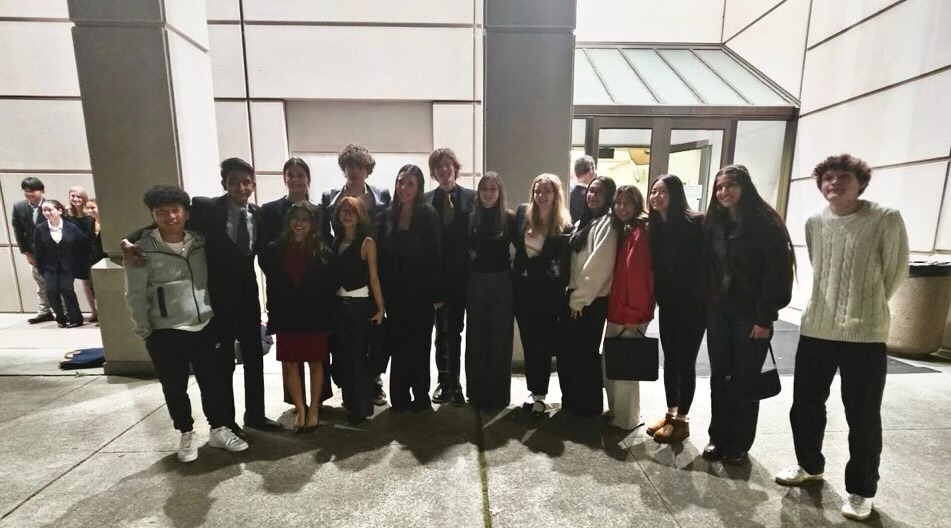
Intro to Law and US History teacher Chad Geernaert has been leading the team since the 90s, and has brought them through multiple championships. Luckily for him, the team this year is particularly strong and is optimistic about their chances of making it far in the tournament. However, lots of people on the team participate because of their passion for learning the law, with the competition being a bonus.
“I think [Mock Trial is] important because it helps with civil advocacy and an understanding of how our legal system works,” said junior and Mock Trial defense attorney Anirudh Venkatraman. “It’s also fun and builds connections across grades.”
Venkatraman and others strongly encourage people to join the class, and for interested parties, auditions for next year’s positions are in March. For anyone interested in law, debate, or performing without worrying about being on stage, Mock Trial is a challenging and entertaining introduction to real-life bureaucratic procedure.